Dutch Fusion Day 2026
08-05-2026
Dutch Fusion Day 2026:
What’s needed to move from physics to actual machines
During the third edition of the Dutch Fusion Day on Friday 8 May, 2026, industry, start-ups and research partners shared their views on how to establish the required supply chains for large scale development and deployment of fusion reactors. This year’s edition of the annual event for the Dutch fusion sector organized by DIFFER, TU/e, and BigScienceNL, welcomed some 200 participants to the DIFFER premises.
‘The fusion landscape is changing due to increasing involvement of startups and scale-ups, accelerating the development of fusion technology,’ observed chair of the day David van Walderveen during his opening statement. ‘Today is about aligning the Dutch high quality industry with fusion research, and developing new partnerships between public and private parties in this sector,’ DIFFER director Marco de Baar added.
Fusion technology is finding itself in the classical innovator’s dilemma between publicly funded projects and private actors applying the ‘fail fast’ mantra and pushing innovation into the field, argued the first speaker of the day, Greg De Temmerman from Techleap. In his talk, he explained how what is currently happening in fusion is deeply rooted in what is happening in deep tech. ‘In the route between basic research and deployment, deep tech is facing four Valleys of Death,’ he lectured, ‘going from startup formation and product development to market validation and establishing a track record. In the field of fusion, we see the first startups starting to struggle, as fusion is still a high risk technology at a low TRL level, that is only beginning to enter the demonstration phase.’
Supply chain challenges
Instead of technical challenges, the field is increasingly starting to face operational supply chain challenges, illustrated Barrington D’Arcy from Proxima Fusion, a three-year old company that is delivering a Q>1 demonstrator stellarator in Germany before building a first of a kind fusion power plant. ‘This first demonstrator called Alpha is all about derisking. We want to gain experience and boost confidence that we can actually build the magnets, the gyrotrons, the heating and cooling and power infrastructure, and the support structure.’ Despite the relatively modest size of the demonstrator, for Alpha alone, the company still needs to produce over 130 kilometers of cable, and needs to acquire some 19,000 kilometers of High-Temperature Superconducting (HTS) tape. ‘Where should this tape come from? The biggest challenge is finding suppliers with fusion experience, and the time to work with suppliers who don’t have experience with fusion yet. We need to think about how we can expand the fusion industry and grow together.’
ASML of fusion
In an attempt to solve some of the problems with required specialized supplies, Renaissance Fusion decided to combine building a stellarator with providing HTS magnets themselves, explained Victor Prast. ‘We are building a fusion machine that is designed for simplicity and cost reduction, with simplified high field compact stellarators based on thick flowing liquid metal walls and laser engraved wide HTS magnets. At the moment, the demand for components is way bigger than the production capacity of the market, hindering scalability. That is why we decided to manufacture our enabling technologies in house. Ultimately, we want to become the ASML of fusion: a key player that builds enabling technologies everyone in the industry needs.’
Seizing the Apollo moment
After the lunch break, Debbie Kempton from UK Fusion Energy took the stage to explain about the UK’s plans take fusion from the lab to the grid with its STEP program, aimed at building a Spherical Tokamak for Energy Production that generates net energy. ‘This an Apollo moment,’ she stated. ‘Commercial appetite is now staring to align with technological optimism, creating a wealth of opportunities. Like with space missions, fusion offers huge potential for spin-outs in terms of applications, investments, and for inspiring new generations to go into STEM. Just as the Apollo mission was about much more than a trip to the moon, fusion is about way more than energy alone.’
Testing facilities
Besides resources in terms of systems, components, and qualified people, future fusion plants also need new types of control and qualification systems. Philippe Cara from the IFMIF-DONES program explained how they are building a neutron source required for qualification of materials to be used in the DEMOnstration power plant (DEMO) that will serve as the electricity-producing machine that follows ITER. He discussed the program’s timeline, experimental capabilities, and the major technical systems, being the accelerator, lithium target loop, test modules, remote handling, and controls. ‘Construction will start in December 2026, and the source will be in operation for 30 years,’ he explained.
The Dutch Fusion Day ended with a panel interview with representatives from VDL ETG, Brainport Development, Somni Solutions, TNO-ESI, and DIFFER. Topics that were discussed ranged from the value DIFFER can add to the emerging Dutch fusion sector, how to win ITER tenders, and the importance of systems engineering for moving into the next phase of fusion, to the role of the Brainport region in establishing a Dutch fusion industry and the commercial opportunities the field has to offer.
Develop a position
Marco de Baar closed the day with a heartfelt call to action. ‘In the Netherlands, we are good at a number of topics that are very relevant for fusion: materials research, superconducting high quality systems, advanced instrumentation, and control systems. We can position ourselves here by focusing on enabling technologies that are technology-agnostic. There is a national ambition to go to Generation III fission reactors, but currently, the supply chain for that technology is lacking. The promise of fusion can help get commercial parties involved in nuclear technology.’ Naomie Verstraeten from Brainport Development wholeheartedly endorsed this appeal. ‘Fusion will become as big an industry as semiconductors. If we do not start to develop a joint position in this field now, we’ll be too late.’
And with that final thought the attendees were sent off to the drinks, to further discuss amongst themselves how to jointly build a flourishing Dutch fusion industry.
TU/e/ Sonja Knols
Online photo album Dutch Fusion Day 2026
Photos by DIFFER/ Bart van Overbeeke
More event reports
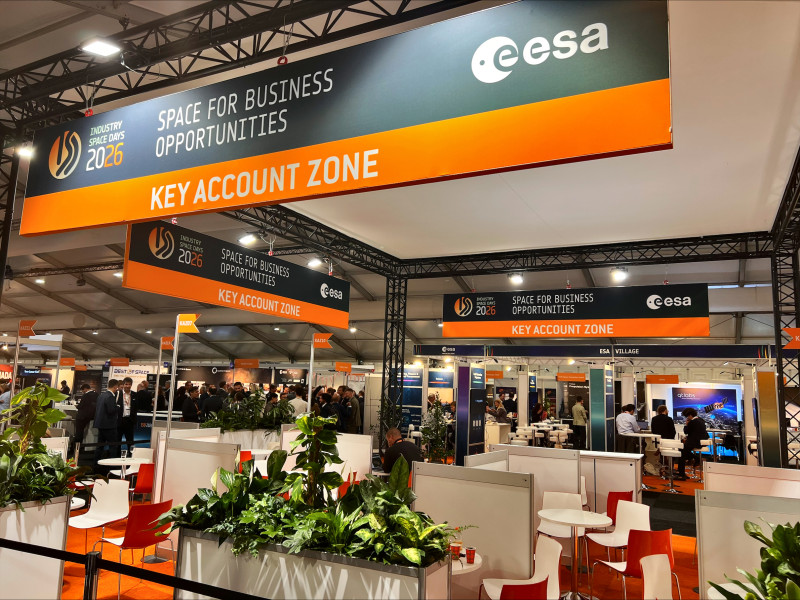
ESA Industry Space Days 2026: record turnout, strong Dutch presence
The 12th ESA Industry Space Days (ISD) took place on 16-17 September 2026 at ESTEC in Noordwijk, and was the largest edition to date. Around 240 exhibitors and more than 3,000 participants attended, representing 1,500 companies from across the European space sector. Attendees pre-arranged over 10,000 pre-arranged business to business meetings, with many more face-to-face encounters on site. More than 50 presentations were delivered across three conference halls.
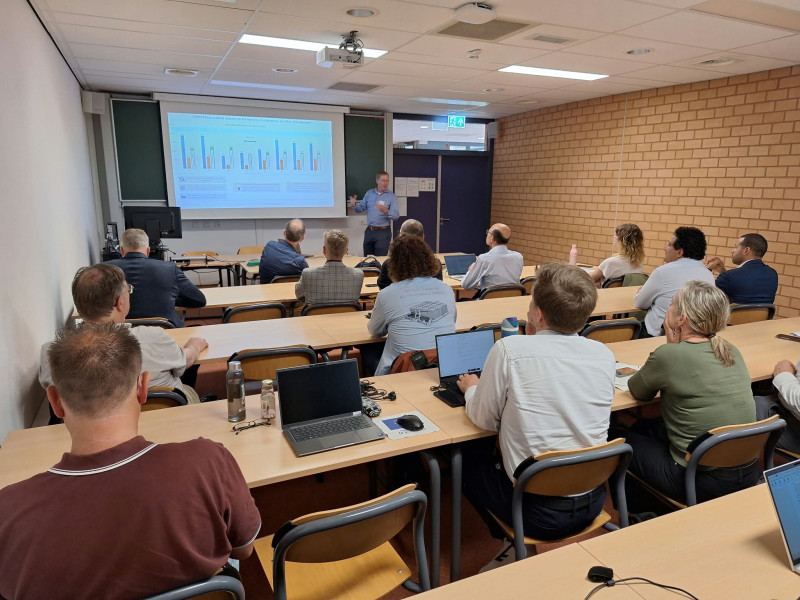
On 2 September, BigScience.NL brought together representatives from industry and research organisations at HFML-FELIX in Nijmegen for an industry meeting dedicated to sustainability. Marc Baldus, Director of HFML-FELIX and profile holder for sustainability within the Dutch NWO institutes, opened the meeting and set the stage for open and lively discussions on this important and timely topic.
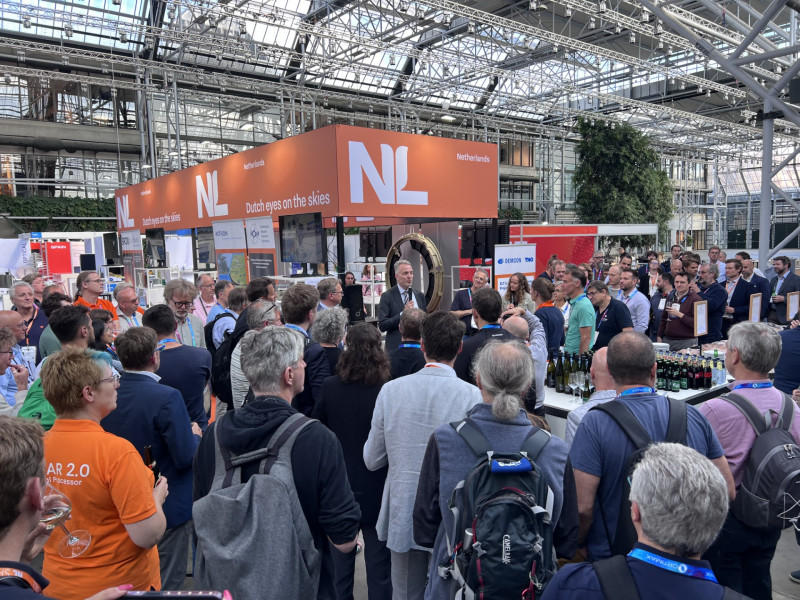
Dutch Astronomical Instrumentation Community Shines at SPIE 2026 in Copenhagen
5–10 July 2026, Copenhagen, Denmark
The astronomical engineering world gathered in Copenhagen for SPIE Astronomical Telescopes + Instrumentation, the leading international conference on ground-based, airborne, and space-based telescopes and the instruments that power them. The event drew more than 3,000 attendees from across the globe, who took part in 13 simultaneous technical conferences featuring over 3,000 presentations on the latest research, technology, and project developments in astronomical instrumentation.